Friday Fun: Geoguessr

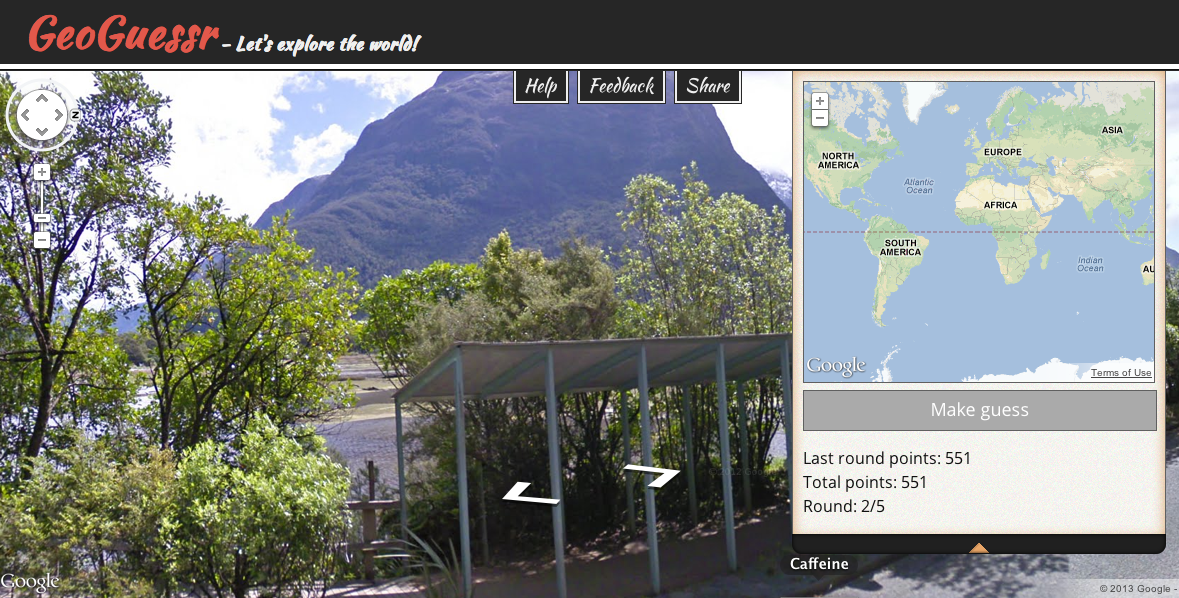
Screen shot 2013-05-10 at 3.48.46 PMThis game is just too fun and addictive (in a nerdy way) to not deserve a post. But first, how many of you geographers have been through something like this:

“Oh, you’re a geographer. [PAUSE] Wow.”
“Yeah.”
“They still have that?”
“Yup.”
“So do you know all the state capitals?”
“Uhhh—”
“You must have a really good sense of direction.”

Fear not, my fellow geographers… Now you can really show off your geographic badassness by trying your luck at GeoGuessr, an online game in which you’re virtually plopped into a random spot in the street-view world of google maps and you’re supposed to guess where in the world you are. You get to poke around a little. The closer to the actual spot, the higher your score. And it shows you how far off the mark your guesses are. You get five “plops” per game.

Posted in Interweb Motley | Leave a comment

Interweb Motley # 20

Happy May Day! Peter Linebaugh has the most “Incomplete, True, Authentic, and Wonderful History of May Day.”

Confessions of a Troll…” about power on the Internets or as a friend put it: the Master-Slave Dialectic in the Age of Digital Reproduction.

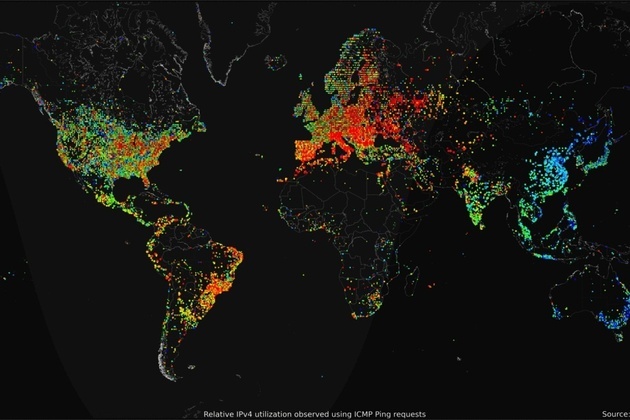
Also about Internets: Stuart Elden pointed me to a piece on how a lone hacker gave us the most complete map of the Internet ever made (see above). S/he mentions wanting to work on an “Internet scale.”

Having a bad day? Would it help if I put it in (temporal) context for you?

Interesting review by Trevor Paglen of Laura Kurgan’s Close Up at a Distance: Mapping, Technology, and Politics.

Posted in Interweb Motley | Leave a comment

Awkward Seas and Exclusive Economic Zones

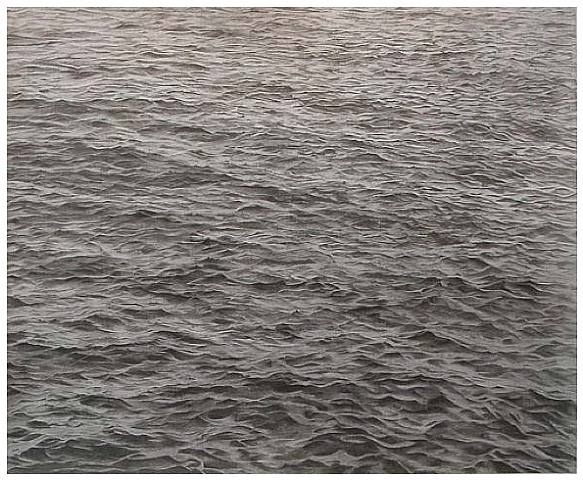
Vija Celmins-UntitledNew Left Review‘s new issue has an article by Peter Nolan that surveys the national “territorial” claims over the world’s oceans: “Imperial Archipelagos.” The sea as an awkward political space is one of those hobby interests of mine that may some day turn into something more. This blog has looked at pirates, off-shore havens (data and finance), sea shores, and in general the legal-political geographies of the sea, so I read Nolan’s piece with interest. His article uses the current dispute between China and Japan over the uninhabited Diaoyu (in Chinese) or Senkaku (in Japanese) island group on the edge of the South China Sea to give a historical survey and global sweep of how resource-hungry world powers have carved up the sea. Below are some excerpts from Nolan’s article, but first one more thing. Continue reading

Posted in Boundaries, Frontiers, Historical-Geographies, Land, Law, Nation/Nationalism, Pirates, Post-Colonial, Power, Sovereignty, Spatiality, Territory, The Sea, The State | Leave a comment

Interweb Motley # 19

Nataliya Slinko-Karl Marx's BeardA new biography by Jonathan Sperber on Karl Marx, which implicitly proposes a materialist account of a materialist thinker, has gotten a glowing review by the NY Times and much less favorable one [PDF] from Terry Eagleton.

The University of Arizona has launched the Public Political Ecology Lab with an accompanying blog.

The International Consortium of Investigative Journalism (ICIJ) released a massive investigative report based on a trove of leaked documents (larger than Wikileaks’ Cablegate) on global money laundering and tax havens: “Secrecy for Sale: Inside the Global Offshore Money Maze.”

A New Yorker piece profiling the work of Neil Freemen, an urban planner, artist, and urban geography provocateur: “The Alternative Geography of Neil Freemen.”

Looking forward to seeing friends and colleagues at the Association of American Geographers’ meeting next week in LA!

Posted in Interweb Motley | 1 Comment

Colombia’s Peace Talks: Independent Republics or Peasant Territories?

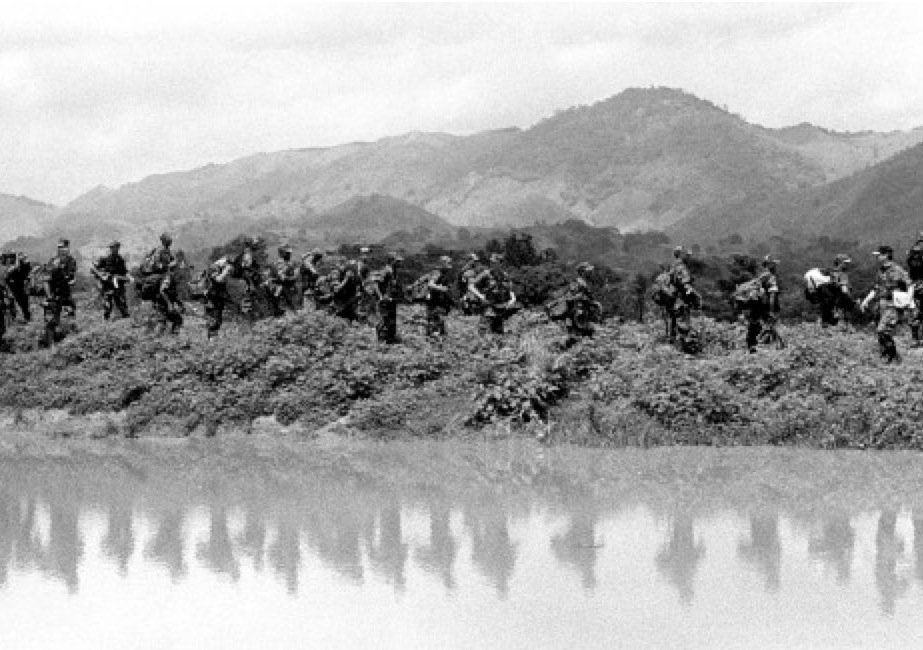
Jesus Abad Colordo-Operacion OrionAfter five months, the Colombian government peace negotiations with the Revolutionary Armed Forces of Colombia (FARC) in Havana are still on the first—and most complicated—item of their five-point negotiating agenda: the restructuring of rural development. Things are moving slowly but steadily, with the government saying they’ve already hammered out a few pages of an agreement. One of the FARC’s main proposals has caused a stir (though it’s unclear how controversial it is at the negotiating table). A central point of the FARC’s proposal is a call for nine million hectares of land—an area approaching the size of Portugal—to be converted into Campesino Reserve Zones (Zonas de Reserva Campesina or ZRC). What’s raised howls from right-wing opponents is the FARC’s suggestion that these ZRCs be given a legal status similar to that of indigenous reserves and Afro-Colombian collective property (i.e. a degree of administrative autonomy). So at this stage the talks hinge on a question of political geography. Continue reading

Posted in Agriculture, Development, Insurgency/Counterinsurgency, Land, Law, Peace, Political Ecology, Political Economy, Security, Sovereignty, Spatiality, Territory, The State | 4 Comments

Interweb Motley # 18

Christoph Gielen-Deer Crest Suburb CaliforniaBuilding the new surveillance state. And guess what? You’re doing it right now. Scary when it’s all laid out for you.

God-tricking super-max prisons in the U.S.? Or visually representing how prison design and architecture “reflect political discourse, economic priorities, cultural sentiments and social insecurities”—from above, of course.

Can the Calafate speak? Malvinas/Falkland Islands being devastated by invasive shrub from Argentina called Calafate.

LA-bound geographers behold the annotated map of The Big Lebowski! AAGs got you down? Celebrate the film’s 15th anniversary with a tour of the city (thx AT!).

The latest on that crazy Charter City idea in Honduras.

And this is what it’s like to have lunch with Noam Chomksy.

Posted in Interweb Motley | Leave a comment

Bureaucracy is Beautiful? Or Death by Papelismo

Bureaucratics-Jan BanningKyle Grayson’s Chasing Dragons pointed me to this extraordinary gallery of photographs called “Bureaucratics” by photographer Jan Banning. I recognized one of them (left): it graces the cover of Akhil Gupta’s new book Red Tape: Bureaucracy, Structural Violence, and Poverty in India. My name for the rule of bureaucracy in Latin America is papelismo. I’ve definitely been in offices with teetering stacks of paper, but nothing like that captured by Banning in India or Yemen. His photos are beautiful, but bureaucracy? Not so much. Gupta and other scholars, e.g. Javier Auyero (Patients of the State: The Politics of Waiting in Argentina), make that much clear. Hannah Arendt defined bureaucracy as “rule by Nobody,” a form of government with such systematic unaccountability that she said it was “clearly the most tyrannical of all.”

Continue reading

Posted in Art, Critique, Everyday Life, Law, Power, The State, Violence | Leave a comment

Hugo Chávez’s legacy: A more independent Latin America

Corazon Chavez-IconoclasistasMy column on Chávez’s death published in McClatchy-Tribune newspapers:

Hugo Chavez proved that Venezuela and the rest of Latin America could chart an independent path in the world.

The Venezuelan leader, who died on March 5, often assumed the role of court jester on the international stage, raising uncomfortable truths by poking fun at the powerful – namely, the United States. But, for Chavez, revolutionizing Venezuela’s political and economic system was a wholly serious matter. Continue reading

Posted in Media, Political Economy, Sovereignty | Leave a comment

Medellín: Who’s Afraid of Hip-Hop?

operation-orion

My article on hip-hop and violence in Medellín is now out:

Héctor Pacheco walked down the steep hillsides of his barrio in Medellín, Colombia to wish his aunt a happy birthday. Pacheco—a local rapper nicknamed “Kolacho”—had spoken at a public event the week before, calling on neighborhood youth to use hip-hop as an instrument for non-violence. As Kolacho began the slow climb back home, gunmen from a motorcycle riddled his body with bullets. He was 20 years old.

“That was one of the hardest blows I’ve ever had to deal with,” says Jeison Castaño, or “Jeihhco,” a fellow rapper and band mate of Kolacho. Since Kolacho’s death in August 2009, nine more young hip-hop activists have been murdered in Medellín. “Being young in this city is a risk in itself,” says Jeihhco. “And being a rapper—out in the streets all the time like we are—is even riskier.”

The violence against hip-hoppers demonstrates the lingering contradictions in a city that has gained global notoriety for its urban security makeover. In the 1990s, international press coverage labelled Medellín the “murder capital of the world,” but with a dramatic drop in violence over the years, headlines began touting the “Medellín Miracle.” Today, the city is nowhere near the violent depths of its past, but things have once again started to unravel and the miracle has lost some of its shine.

The rest of the story (with photos) is available on openDemocracy’s site.

Posted in Art, Boundaries, City, Drugs, Everyday Life, Frontiers, Insurgency/Counterinsurgency, Security, Spatiality, Territory, Terror, The State, Violence | Leave a comment

Althusser, Gramsci and Machiavelli – Us and Us

Couple (I)-Bela KadarDebate in the geograsphere. Jon Beasley-Murray published a riff on Louis Althusser’s Machiavelli and Us saying he detects a post-hegemonic streak in Althusser’s take on Machiavelli with an emphasis on the aleatory, contingent, and the conjunctural rather than a “telos of the nation state.” Adam Morton takes issue with the interpretation, saying it veers too far from the text and ignores the conceptual methodology of the book, concluding that a “move towards a posthegemonic politics should be resisted.” Beasley-Murray responds saying that Morton neglects how aspects of the text are in “sync with the late Althusser’s aleatory materialism of the encounter” in an effort to dismiss posthegemonic politics altogether. Morton says that what’s in and what’s not in the texts is precisely the problem with posthegemony, arguing, for instance, that Beasley-Murray’s notion of “posthegemony” is based on a simplistic and incomplete understanding of how Antonio Gramsci theorized hegemony. And that’s really the rub here. Continue reading

Posted in Antonio Gramsci, Dialectics, Hegemony, Historical Materialism, Marxism, Nation/Nationalism, Niccolo Machiavelli, Power, The State | 4 Comments